

Ed. note: Spoiler alert! This piece discloses some plot details in the novel Trust.
In advance of The Humanities Institute’s 2024 Deep Read, featuring Hernan Diaz’s Pulitzer Prize–winning novel Trust, UCSC students explored the book and Diaz’s other writings in a course with Lecturer and THI Program Manager Laura Martin.

Lecturer and THI Program Manager Laura Martin (photo by Carolyn Lagatutta)
Set in the 1920s and ‘30s, leading up to the 1929 Wall Street Crash, Trust explores financial technology from an historical perspective, while also providing a profound reflection on how power and wealth shape the stories we tell ourselves about the global economy.
The story unfolds in four sections as mini-books within the novel—each providing a shift in perspective and understanding and inviting readers’ questions about how much “trust” can be placed in each competing narrative.
Here, the students in the course provide some of their insights from their close examination of the text (including what’s being said between the lines). For many, it was the first time they’d encountered unreliable narrators, prompting a lot of reflection on the nature of truth—which, in Trust, could depend on who was telling the story.
Some also realized their investigations and discussions answered many questions but prompted more. Perhaps they’ll puzzle over these mysteries for decades to come. Answers may arise as wisdom grows, or remain ambiguous—which is, after all, part of the human condition and essential learning in and of itself.
Opening passageways in the minds of both students and community members to this type of thinking, seeking, questioning, learning, and discussing is among the Deep Read’s—and The Humanities Institute’s—goals.
Mohammad Alhamoudi
Cowell ’25, environmental studies
I learned how different perspectives can really shift the narrative. Diaz does a great job of making the reader question narrators, and the stories. It feels like a detective novel, but you are suspicious of the narrators.
Leah Dautoff
Cowell ’25, literature
We learn through this book that there is no reliable narrator—truth will always be subjective. So what do we define as truth vs. fiction? If Diaz is making a commentary on how history is the truth of the people who got to write down the story, is it true at all? Have we had our pasts erased without realizing it? How can we mitigate this?
I am deeply appreciative of Trust for its profound exploration of the concept of truth, not only within the novel but also in the world around us.

Photo by Carolyn Lagatutta
Brenda Fu
Merrill ’25, literature
From reading Trust and Diaz, I have learned how easily power can manipulate facts. There are many examples of how money and power have distorted the reality in the book, and Diaz demonstrates just how influential money is in society.
Diego Garza
Oakes ’27, linguistics
Trust teaches us that each narrator’s perspective is flawed and unreliable because they’re all biased toward themselves. In response to this, how can we trust our perspective?
Nadia Kositsky
Cowell ’27, literature
Taking the Deep Read course required me to step out of my comfort zone, as I am typically left confused when discussing economics. However, Diaz writes Trust with remarkable accessibility for any reader. After finishing the novel and discussing the narrative with my class, I have a newfound understanding of money and capitalism through the scope of humanity and society.
Gabriel Landeros
Porter ’27, politics
Throughout reading the novel, there was one thing lacking and it was something I felt was constantly missing—what was it? Trust. Diaz has truly made me question the narrator more than any other novel has. I don’t think I’ll ever know an exact truth.
Timothy Liu
Crown ’26, biomolecular engineering and bioinformatics
After reading Trust, I have learned a lot more about reading between the lines and analyzing what was previously read in order to gain better understanding of a novel as a whole. Trust introduces so many complex layers that require readers to really dive into the novel to fully understand the timeline and the many moving parts. A specific insight I gained after reading it is that capitalism may not always look like how it does on the surface.
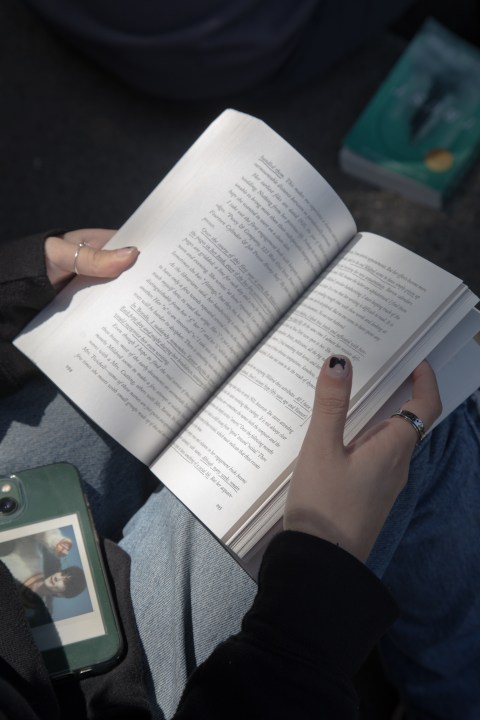
Photo by Carolyn Lagatutta
Fiona Mccormick
Kresge ’26, economics
The book isn’t really about money—it’s about power. The main character—Andrew Bevel—is already rich beyond measure. What he cares about is the power and status that comes from being viewed as this genius financier. The other type of power being discussed here is the power of language. Like his inspiration, Jorge Luis Borges, Diaz views language and literature in a more meta way than most. Throughout the book, we are asked not only to understand what is written on the pages, but also what is not written.
Seiya Mendiola
Porter ’26, literature
The title, Trust, is completely ironic considering how many times Diaz flipped the readers’ trust on its head.
Judith Montenegro
College Nine ’25, literature
While reading Trust for the first time, my classmates and I discussed how each story presented in the novel fills in another story’s gaps. And that led me to believe that this book was meant to teach its audience about unreliable narrators and the dangers that come with believing everything at face value. But the larger, overarching message is how economic power can influence, create, or even destroy narratives. And that it is our jobs as readers and archivists in our own right to ensure narratives continue existing even if they make others uncomfortable with their truth.
Natalie Parker Blount
Oakes ’27, business management economics
It really makes you think about the way that you are handed information and reminds you to think critically about it. It also shows a scary side of capitalism that should be concerning to all of us. It puts into perspective the power that money and the upper class has over us—including the power to bend reality.
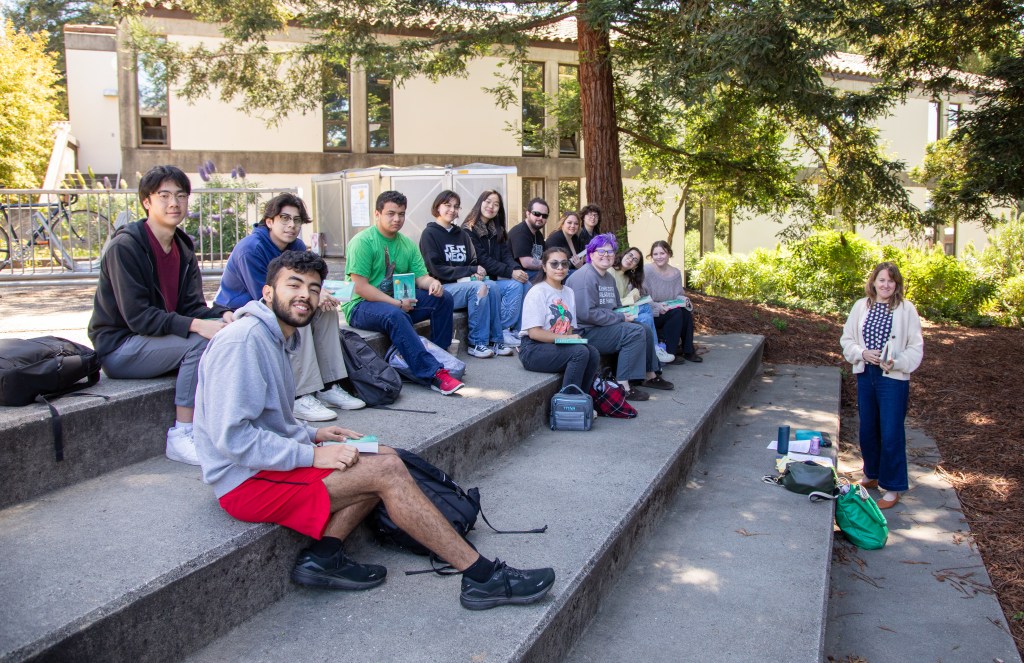
Martin and the Deep Read course students took class outside on a recent warm spring day, discussing Trust among the redwoods. (Photo by Carolyn Lagatutta)
Francisco Porras
Oakes ’27, marine biology
Using fiction to combat narratives is an interesting way to criticize society. The historical narrative is of tycoons running the world during a great crisis, trying to prop up the market for their own gain while maintaining an image of goodness and charity for the commoners.
Max Rothe
Oakes ’27, psychology
Reading Trust taught me to question the validity of what public figures say and put out. The novel shows us that individuals with immense power have the ability to manipulate reality. We can see that marginalized voices (women, queer, disabled folk, etc.) have the obstacle of (usually male) individuals centering themselves constantly and making decisions for the community as a whole.
I have to question what Diaz’s role is in the telling of this story, since it is about the marginalization of women. What was the drive to share this narrative? Did he think it would be more credible coming from a male author? Would he consider himself a feminist?
Ado Vital
Kresge ’27, film and digital media studies
After reading Trust I learned a lot about perspective and different forms of power, as well as how power is used to manipulate others on a bigger scale than I thought. I was able to pick up how Diaz was able to write this after looking more into the background of him
and his inspiration. Going forward I want to do this with any form of media or art because I think it says a lot about the creator and helps us appreciate it more. In general, Trust and Diaz reminded me how poetic and beautiful storytelling can be, and the messages they can subtly push and use to tell a grander story.